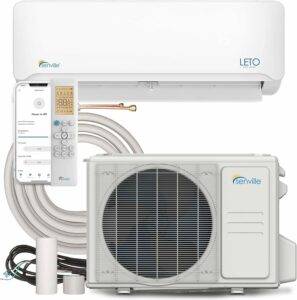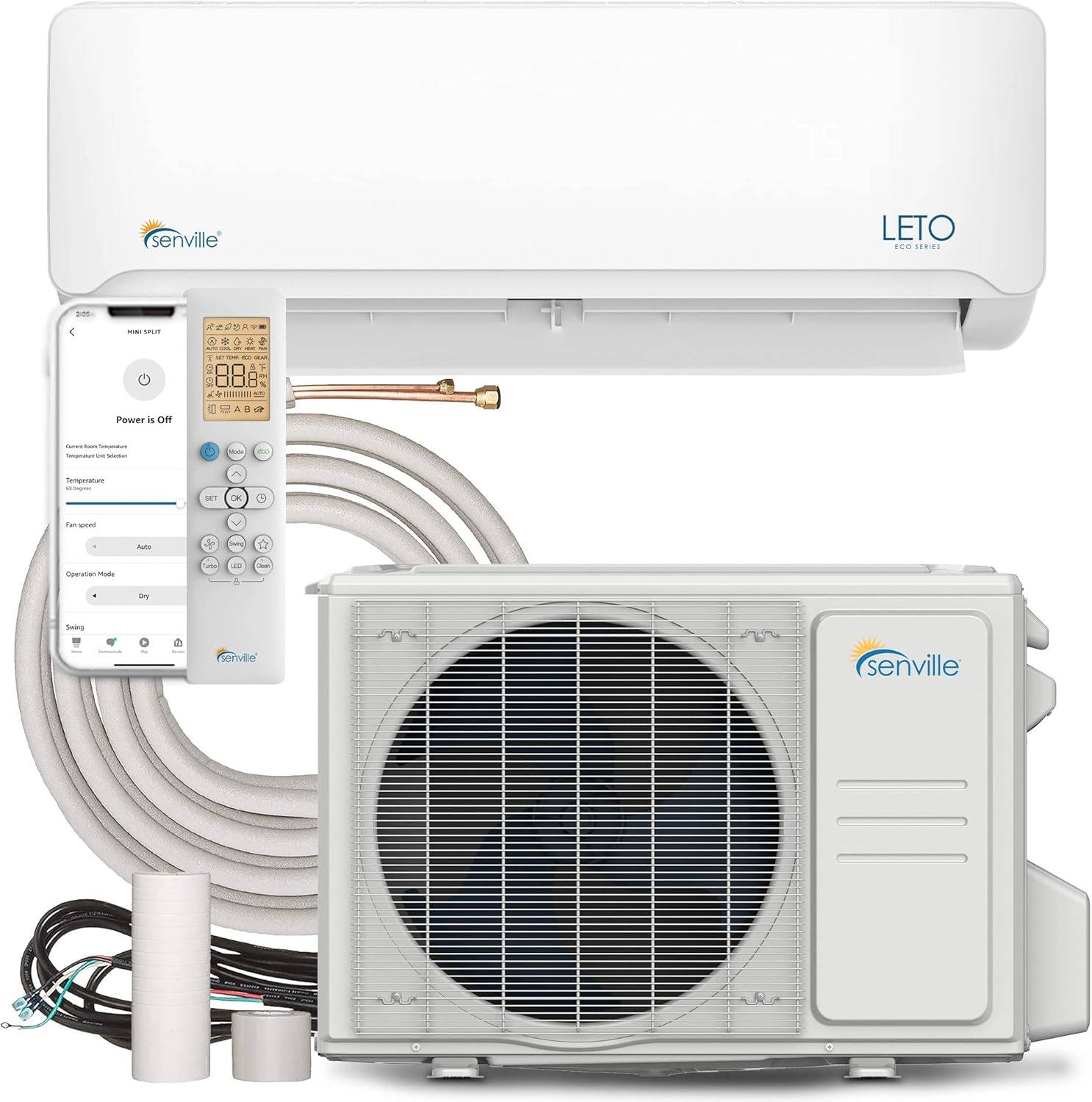


allowing you to adjust your mini split air conditioner from anywhere. Set routines for temperature changes.Versatile 4-in-1 Mini Split: All-season solution with air conditioning, heat pump (functional up to 5F/-15C), dehumidifier, fan, and turbo function. Includes a DC Inverter that’s UL Listed, AHRI Certified, and works with Alexa.Stylish & Functional Mini Split AC: Suitable for both home and business. Provides performance without compromising aesthetics. Ideal for bedrooms, living areas, stores, eateries, and warehouses.Installation Package Included: Includes indoor air handler, outdoor condenser, remote control, and installation kit with a 16ft. line set and communication wire. Pre-loaded with refrigerant for up to 25 ft.
Norm’s system uses a large homemade solar heat storage and drain back tank to provide solar space heating and domestic water heating for his home in Maine. The system integrates the solar heating with a boiler that provides the space and water heating functions when the solar water is not hot enough.
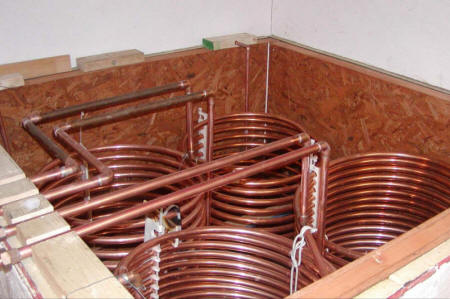
The tank, plumbing and heat exchangers are very nicely done and provide a lot of good ideas and construction details. |
Overview

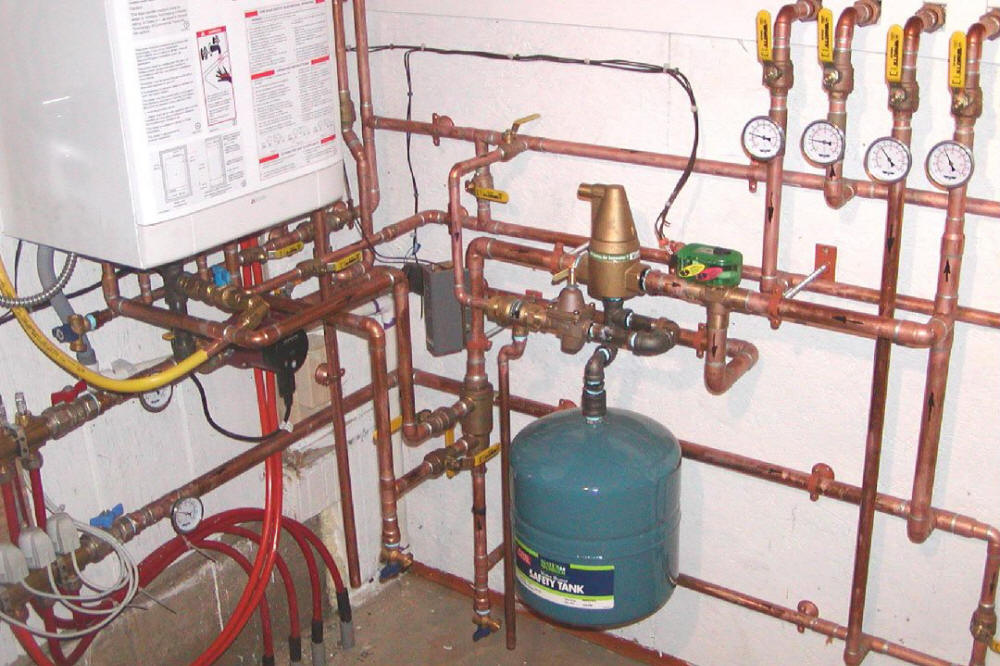
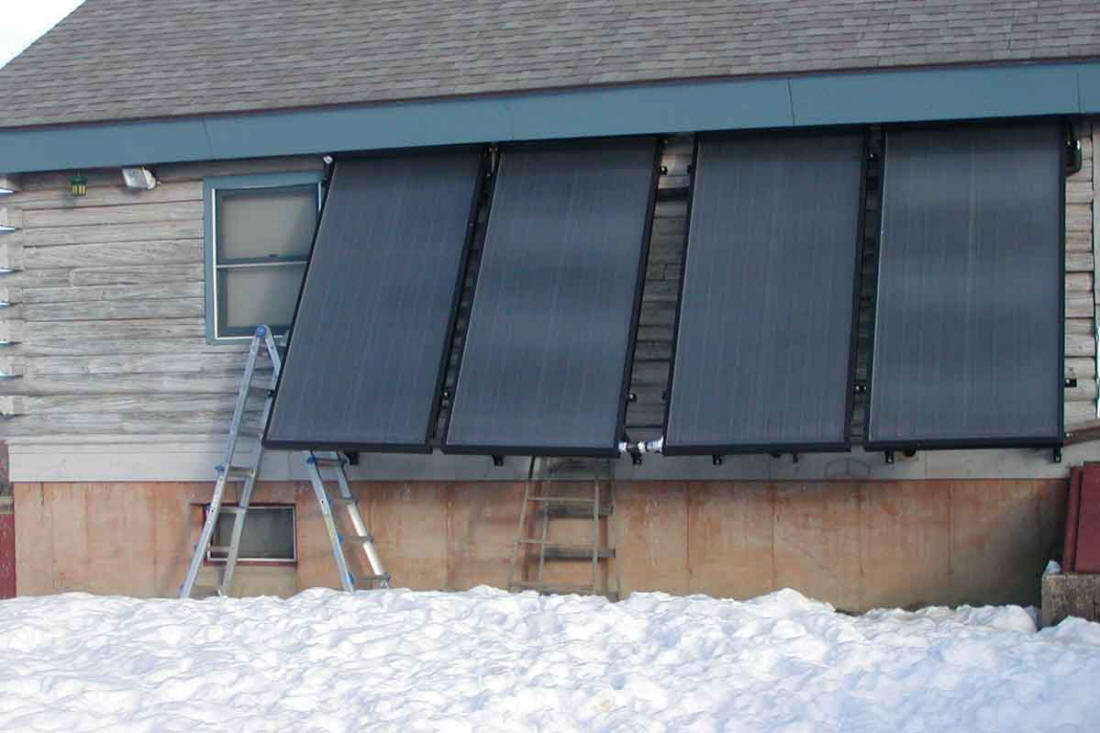
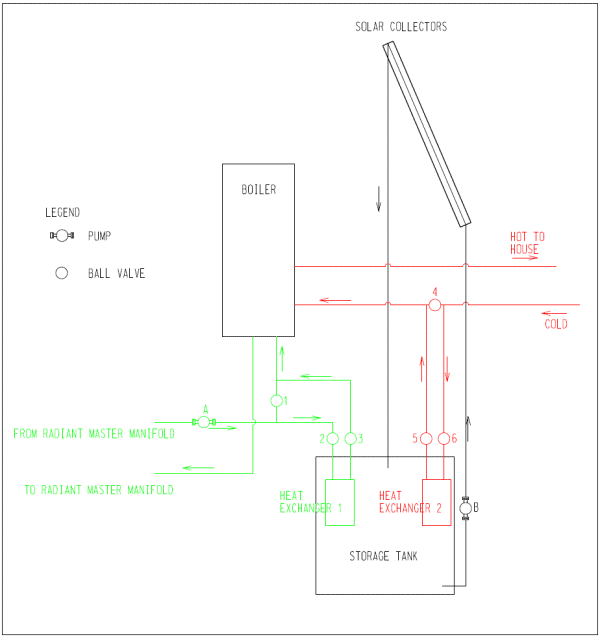
This temperature was arrived at by running a flow test and determining that the DHW coil in the solar tank will deliver 120 F water continuously when the tank temperature is 125 F.Also the space heating coils will deliver essentially 125 F water to the input of the boiler. Since this is above the normal temperature required for supply to the floor, there is no need for the boiler to run. Both sets of coils in the solar tank can be shut off with ball valves, if need be, and then the boiler will provide DHW and space heating.The input and output of both sets of coils and the supply and return of the radiant floor have inline thermometers to provide information on system operation. There are four SunEarth Empire EC-32 collectors, attached to the south wall of our log home, that have water pumped through them by a three speed Grundfos Alpha pump. I have the pump set to operate at the middle speed. The pump is controlled by a Solar Thermal differential controller that senses the water temperature at the top and bottom of the tank and also the temperature of the air inside the collectors. The controller is set to allow a maximum temperature of 140 F inside the tank. If the tank temperature is below 140, the controller is further set to start the pump any time the collector temperature is more that 16 degrees above the bottom water temperature. The controller turns the pump off if the collector temperature falls to within 8 degrees of the tank water temperature. At this point all the water in the collectors drains back to the tank. The controller has a safety feature which prevents starting the pump if the collector temperature is above a preset upper limit to prevent steam generation. The circulation piping has a Pentair flowmeter which shows water flow rate while the pump is running and acts a sight glass for tank water level when the pump is idle.
This system is used to provide heated water to two different types of radiant floor heating systems. One part of the heating system is the conventional Pex tubing in concrete floor in the basement area of the new addition.
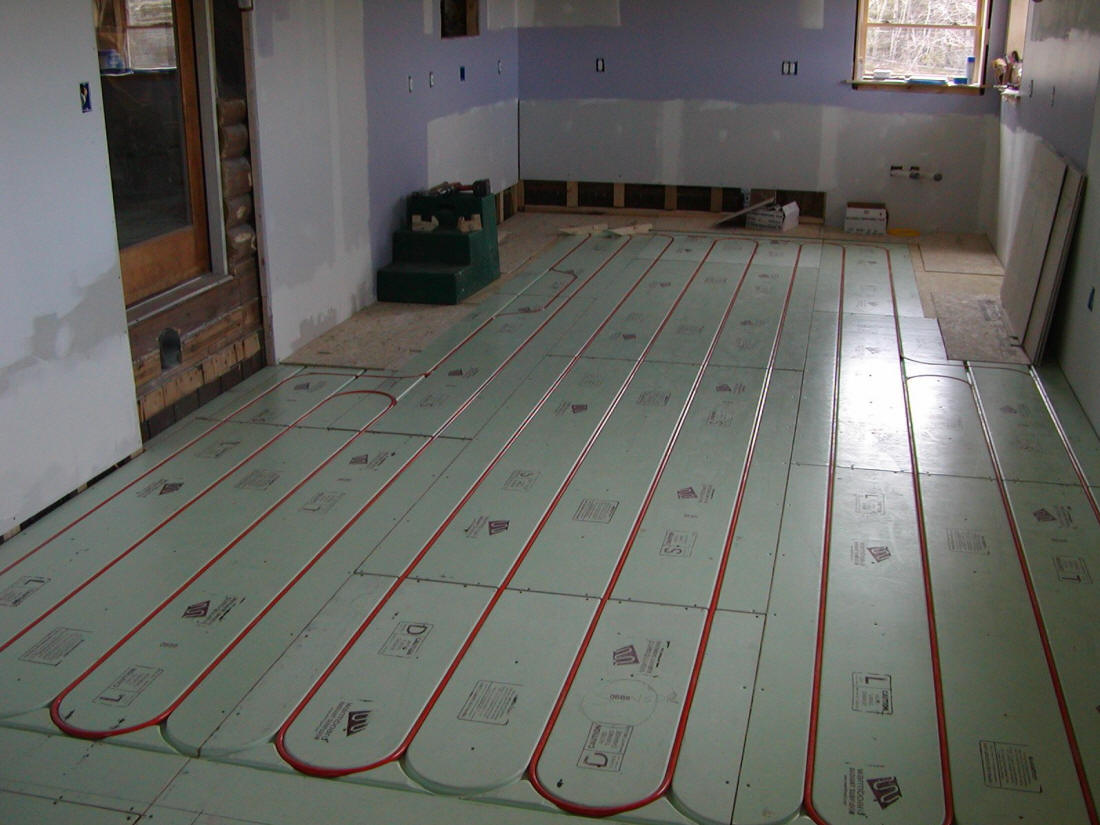
The first floor of the addition uses Warmboard with Pex-Al-Pex under ceramic tile. The water is circulated through the boiler and the tank heat exchangers by a variable speed Grundfos pump.
The individual zones are regulated by thermostatically controlled valves. At the present time there are four zones working and plans are underway to install four more loops in the old part of the house. These will replace the existing forced hot air system currently in use.
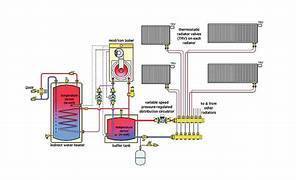
System schematic diagram As shown in the schematic, all items in green are parts of the space heating side of the system and the items in red are part of the domestic hot water side.
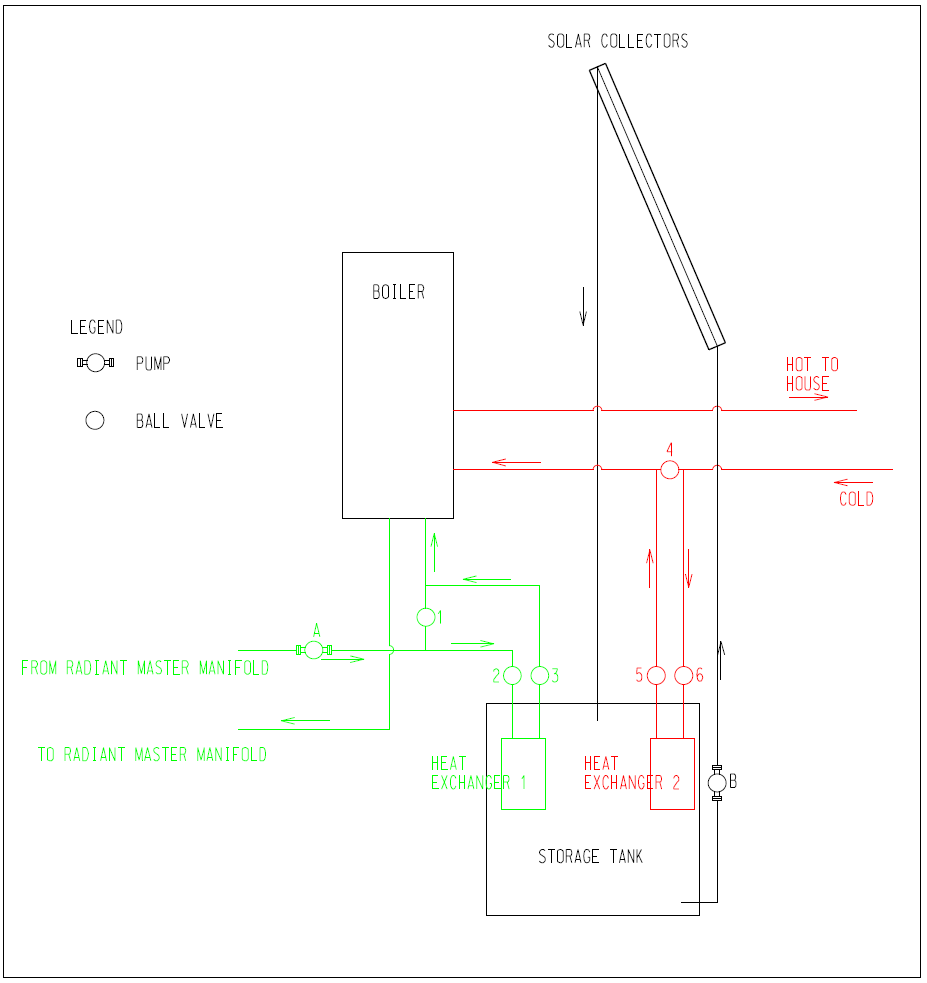
In normal operation valves 2,3,5 and 6 are normally open to allow water to flow through the respective heat exchangers. Valves 1 and 4 are normally closed. If for any reason, it is desired to have the boiler operate without any boost from the solar tank, valves 1 and 4 would be opened and 2,3,5 and 6 would be closed.Pump A is part of the boiler installation and pump B is dedicated solely to pumping water to the solar collectors.Heat exchanger 1 consists of two 90′ coils of 3/4” copper connected in parallel. Heat exchanger 2 has two 60′ coils but otherwise is the same as 1.The boiler that I used has a primary heat exchanger for space heating and a secondary for DHW. Heat Storage Tank. The tank was sized to accept a liner purchased from Tom Gocze at American Solartechnics in Searsport, Maine. The inside dimensions are 55”x55”x48” h. The tank is made from four panels for the side walls, a platform and a removable cover. The cover is sealed on the edges with 0.5” round foam insulation to cut down on evaporation loss. The construction of the tankverticallpanels, platform and cover are described below. panels, platform and cover are described below.

A split-system central air conditioner has 3 components: An outdoor metal cabinet that contains the condenser and compressor. An indoor cabinet that contains the evaporator coil An air handler, that in most cases is part of the furnace, that sends the cool air through the duct system. If your home already has a furnace but no air conditioner, a split-system is the most economical central air conditioner to install. A packaged central air conditioner has the evaporator coil, condenser, and compressor all located in one cabinet, which usually is placed on a roof or on a concrete slab next to the house’s foundation. This type of air conditioner also is used in small commercial buildings. Air supply and return ducts come from indoors through the home’s exterior wall or roof to connect with the packaged air conditioner, which is usually located outdoors. Packaged air conditioners often include electric heating coils or a natural gas furnace. This combination of air conditioner and central heater eliminates the need for a separate furnace indoors. It is generally easier to achieve high efficiency with a split system than with a packaged system.
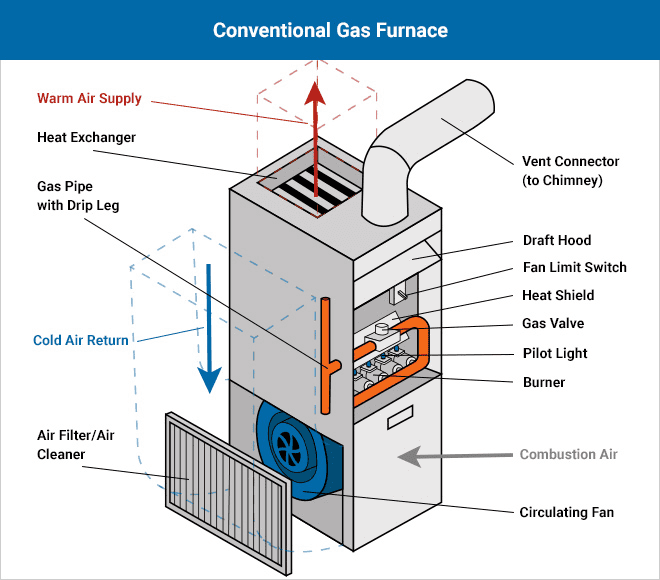
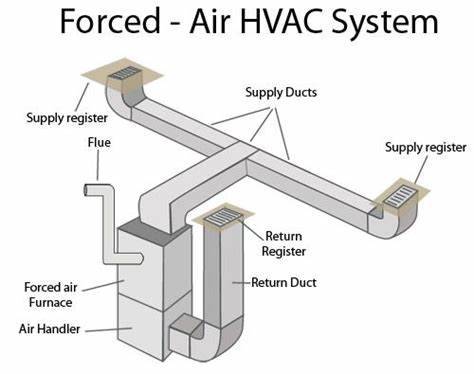
A forced-air central heating system is one which uses air as its heat transfer medium. These systems rely on ductwork, vents, and plenums as means of air distribution, separate from the actual heating and air conditioning systems. The return plenum carries the air from several large return grills to a central air handler for re-heating. The supply plenum directs air from the central unit to the rooms which the system is designed to heat. Regardless of type, all air handlers consist of an air filter, blower, heat exchanger/element/coil, and various controls. Like any other kind of central heating system, thermostats are used to control forced air heating systems.
Some of the oldest and most common examples are steam and hot-water radiators. Historically, in large-scale commercial buildings such as high-rise and campus facilities, a hydronic system may include both a chilled and a heated water loop, to provide for both heating and air conditioning. Chillers and cooling towers are used either separately or together as means to provide water cooling, while boilers heat water. A recent innovation is the chiller boiler system, which provides an efficient form of HVAC for homes and smaller commercial spaces.
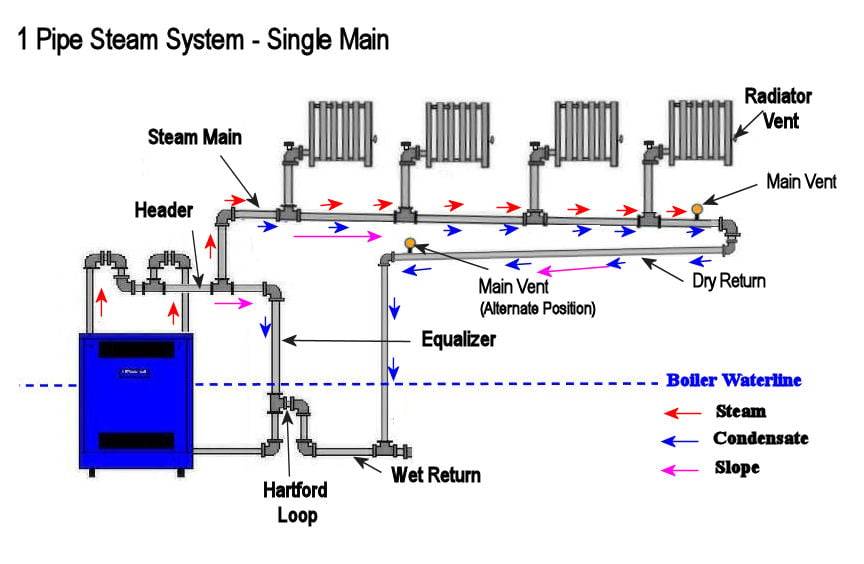
As the steam cools, it condenses back into water, and returns to the boiler to be heated again. Steam Heating Systems Maintenance. While one of the advantages of boiler systems is their long life, they should still be serviced annually to ensure trouble-free operation. You can easily learn to check the safety valve, pressure level gauge, and water level gauge yourself, but for safety reasons more substantial heating system maintenance should be done by qualified service professional. Routine annual service should include checking the controls and gauges and inspecting and adjusting the burner. In addition, the chimney and flues from the boiler should be inspected for blockages or leaks, as well. If you have steam heating, the air valves on the radiators should also be checked and adjusted to regulate the heat.
In general steam heating isn’t as efficient, provides less even heating, and presents a greater safety risk than other heating options. Add to that the fact that steam heating requires diligent regular maintenance if you expect your system to last, and it’s easy to see why many homeowners choose to replace steam heating systems with more conventional heating options. In fact, if you have a system that is struggling or not working properly, you’re probably wise to invest in a forced air furnace instead. The energy savings you experience, along with the convenience of maintenance free operation, make replacing steam heating systems a smart decision for any homeowner.
Simultaneously colder air enters through the bottom of the unit to be warmed. Thermostats are still used in a room-by-room basis. Once the air entering the baseboard unit reaches the desired temperature, the unit will shut off until it is needed again. This allows homeowners to heat rooms individually, recovering some of the lost efficiency. This needs to be done by adjusting the thermostat to a lower temperature in unused rooms. Turning the unit off may cause pipes to freeze and crack.
heating units to heat rooms. These heaters are an efficient heat source. In fact, they tend to be more efficient than other central heating systems. Hydronic heating is ideally used with radiant heat systems, where the heating pipes run under your floor. Flooring in many homes, however, make this installation impractical. Hot water baseboard heaters are an excellent alternative for hydronic heating without causing the initial installation to skyrocket.